Tuesday, November 26, 2013

Review: The Secret House by Edgar Wallace

by Mary

As is usual with Wallace's works, The Secret House gallops off to a cracking good start with a seedy fellow being interviewed for a job as assistant to the editor of a scandal rag called The Gossip's Corner -- an editor whose face is concealed during the interview by a bag-like fine silk veil tied under his chin. That would give most people pause, but the applicant takes it in his stride and gets the job.

Not long afterwards a millionaire named Farrington overhears two men arguing virtually on his doorstep about turning in the notorious blackmailer Montague Fallock, a man of whom there is no known photograph. Suddenly two shots are heard and both men lie dead.

Naturally when the police arrive Farrington's house is searched. Assistant commissioner T. B. Smith of Scotland Yard (who happens to live in the same London square) discovers the millionaire's area door is ajar. Not only that but he also picks up a gold scent bottle with the same perfume he detected in Farrington's hall although it is not that used by Doris Gray, Farrington's niece and ward. The only other clue is a silver locket engraved with a couple of lines whose meaning is unfathomable, discovered on one of the dead men.

Among other characters the reader meets Frank Doughton, who loves Doris, adventurer Count Paltavo, Doughton's rival for her affections, Lady Constance Dex, friend to Farrington and Doris, and Dr Fall, physician to Mr Jim Moole. Mr Moole is the never seen eccentric owner of The Secret House in the village of Great Bradley, and many are the stories told about him.

My verdict: The plot is a rich stew of sinister foreigners, fraud, murder, the search for a missing heir, a most peculiar will left by a suicide, disappearances, rooms that change in the twinkling of the proverbial eye, revenge, and much more besides. While some elements are far-fetched, still it's one of those yarns carrying the reader along at a breakneck pace until an unusual denouement putting Smith in danger of...well, better not say, but as a hint alert the reader to consider the estate on which stands The Secret House.

Etext: http://www.munseys.com/diskfive/sechousedex.htm

Saturday, November 9, 2013

FIRE-TONGUE BY SAX ROHMER (REVIEW)

by Mary

If only Sir Charles Abingdon had confided in Paul Harley right away instead of deciding to reveal the full extent of his fears over dinner the following evening...but he didn't and is just about to tell all when he dies at the dinner table. Sir Charles' last words are "Fire-Tongue...Nicol Brinn...."

Nicol Brinn is easy enough to find, being a world-famous daredevil hunter and explorer who's been courting death for years in all parts of the globe, but when Harvey mentions Fire-Tongue he is obviously shaken to his core. Yet he too refuses, for the moment at least, to reveal what he knows of Fire-Tongue. Meantime, Harvey meets and falls for Sir Charles' daughter Phyllis and is not thrilled to hear the effete, hyacinth-loving Persian Ormuz Khan is paying her too much attention, or at least according to views held by British gentlemen on what constitutes proper conduct. It's up to Harvey and Brinn, working with Inspector Wessex and his colleagues, to deduce the mysterious entity's identity and thwart whatever devilish plans he or she is doubtless hatching.

My verdict: Fire-Tongue is curiously subdued for Rohmer. Its solution depends more on deduction and investigation than on fisticuffs, although a chilling chase along a deserted country road and the usual derring-do in an isolated mansion do feature. Part of the back story strays into classic Rohmer territory, which is to say it is more than somewhat far fetched, but here it explains a great deal about a pivotal character. Not a bad read for an idle evening.

Etext: Fire-Tongue

Friday, August 23, 2013

Ronald Standish by Sapper (A Review)

by Mary

Narrated by Bob Miller, this collection of short stories involves his friend Ronald Standish. Wealthy and something of a sportsman -- particularly keen on golf and cricket -- Standish only takes cases that interest him and having done so persists until he solves them or, according to Miller and unusually for amateur detectives, must own himself beaten. His greatest assets when investigations are afoot are an excellent memory for faces and unusual facts and a talent for noticing small details others have missed.

In this entertaining work, Miller relates several investigations undertaken by Standish.

THE CREAKING DOOR tells what it knows and thus aids the discovery of the culprit when an artist is murdered after a scene precipitated by his kissing a girl against her will. The story ends with a rather nasty twist.

THE MISSING CHAUFFEUR works for the Duke of Dorset and has done a bunk the week before Grand Duke Sergius of Russia is due to stay for a few days. A letter written in blood arrives...

Visiting the small Cornish town of St Porodoc,, Standish and Miller hear a strange tale from a young curate who sees a ghost in THE HAUNTED RECTORY. A garden snail points to the solution of the mystery.

Love's young dream is thwarted by lack of cash, and when a valuable tiara is stolen only the suspect's beloved believes him innocent. It takes A MATTER OF TAR to show who was really responsible for the theft and associated assault.

The sister of one of Standish's fellow cricket-players consults the detective about her new neighbour, who runs a boarding kennel but mistakes an Irish terrier for an Airedale -- and reacts with fury when corrected. And whose is the terrified face seen peering from a window of THE HOUSE WITH THE KENNELS?

Standish is consulted about a letter his client's uncle received instructing certain papers be left in a specified place. Not long afterwards the uncle fell to his death, his son came into the estate, is sent an identical communication, and in turns dies. What will THE THIRD MESSAGE say?

It takes Standish some thought to solve THE MYSTERY OF THE SLIP COACH, wherein a man is found shot to death on a train with a smashed egg splashed about his compartment in a nice example of the locked room mystery.

An extremely unpopular village resident is found murdered and nobody mourns him. It looks bad for the man with more than one reason for a grudge against the departed. THE SECOND DOG provides the clue clinching the solution to a case of revenge....

Threats from Indian priests over disrespectful behaviour toward temple dancing girls follow a man who has returned to England and who now fears for the safety of his niece at the hands of THE MAN IN YELLOW seen flitting about the house and yet never found.

A blackmailing cur is brought to book by THE MAN WITH SAMPLES in a story getting my vote for the best in the collection, not least because of the method used to catch him, which neatly sidesteps a situation in which as is usual with blackmail his victims are very reluctant to involve the police.

When a retired businessman purchases THE EMPTY HOUSE and arranges for its renovation, incidents of vandalism begin and he receives warnings he will regret taking up residence, escalating in an attempt to run him down. Yet what could be the reason?

An obnoxious landowner is found drowned in THE TIDAL RIVER and a young man is brought to trial on charges of murdering him in what appears to be an open and shut case. But Standish casts his line out for other fish..

My verdict: An enjoyable read presenting challenges of various degrees to those who enjoy trying to guess whodunnit. Standish is more of a cerebral detective than a scientific sleuth, which will add interest for those who like their crimes solved without bubbling test tubes or advanced electrical whatnots getting involved.

Etext: http://gutenberg.net.au/ebooks06/0607761.txt

Sunday, June 16, 2013

Stick Figures to Schiele

Yes, once again it is time for the Orphan Scrivener newsletter online. This time, in addition to the usual BSP, Mary offers musings about the paintings of Edward Hopper and I continue in a similar vein:

STICK FIGURES TO SCHIELE

One of the great things about the Internet is the amount of artwork on display. I could never afford coffee table books full of reproductions and rarely had the opportunity to visit museums or galleries, but today, thanks to endless web galleries, my computer desktop displays a rotating art show featuring paintings by Edward Hopper, Andrew Wyeth, Pierre Bonnard, Egon Schiele, Gustav Klimt, and many more. Yes, I admit that I even have some non-classical works such as Weird Tales covers by Margaret Brundage.

My taste in art, like my taste in literature, is rather conservative -- some might say backward looking. I prefer figurative to abstract. I like impressionism. I enjoy the realistic tour de forces of Alma-Tadema and other Victorians. The work of the Pre-Raphaelites fascinates me. I prefer a picture that tells a story, which is probably why I never aspired to be an artist.

Not that I haven't dabbled in art. I was always well supplied with paper and crayons, not to mention pencils, pens, paints, pastels, and charcoal. As a kid I spent almost as much time drawing as playing in the backyard. Often my friend from next door would come over and instead of re-enacting the Gunfight at the O.K. Corral again we'd sit on my grandparents' porch and draw endless cartoon stories -- featuring plenty of guns and bombs -- on the rolls of adding machine paper my grandfather brought home from work. Those stories would keep getting longer and more exciting and violent until the long strips of uncoiling adventures began to flap in the passing breezes.

I had drawn stories long before I learned the alphabet. When I became proficient at writing I added captions to my drawings or word balloons. Instead of learning the multiplication tables I'd sit in the back of the classroom and draw cartoons for my buddies, including plenty of guns and bombs.

There were periods in my youth when I thought I might be an artist but I was never much good at drawing, nor was I inclined to work at it very hard. I have always liked drawing birds because they don't have those dreadfully complicated hands (now let's see, looking at the hand like that, which side should the thumb be on?) or even mouths to get wrong. For a couple of years I produced stick figure "mini-comics'. (More than twenty-five years ago -- long before XKCD -- amateur comics enthusiasts were employing stick figures, which allowed even those who couldn't draw to make comics.)

I came to realize that I was not interested in visual art for itself but only as a means to say things that were better -- and in my case more easily -- expressed in words. I was better served practicing my writing rather than my drawing.

There is a lot written about the "meaning" of books and paintings and other art forms, as if the works themselves are a sort of complicated shell within which the artist has concealed what he wants to express in such a way that it needs to be winkled out by experts. But if the purpose of a novel or a painting was to say something that could be said in a paragraph then the author would have written that paragraph instead of the novel and the painter would have placed himself in front of a keyboard rather than an easel.

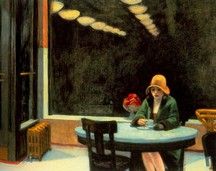
Paintings are in large part about what we see -- form, color, light. Just as music is about sound. Writing about a painting in words gives the impression that the painting is about something that could have been expressed in words, which is misleading. Abstract paintings are purely visual, which is probably why I prefer paintings with some lingering attachment to real objects. In a Hopper I can find a bit of the literal element -- the story -- that attracts me, to go along with the visual. I cannot enjoy a visual experience much when it is entirely unhinged from any literal interpretation.

I have read psychological analyses of Hopper's works, often stressing the sense of loneliness and isolation, and while there is likely some truth to this I suspect Hopper was much more concerned with shapes and light, even in those paintings which feature human figures.

Probably I project more literal meaning onto the works of Hopper and other figurative painters than they intended. That's because I am literal minded. I am story oriented. Had I chosen to pursue art I could only have been an illustrator and the role of the illustrator is diminished in these days of cameras and computers anyway. Deciding to write was a good choice. But I think that my artistic upbringing and inclinations sometimes help me visualize the sixth century world Mary and I write about. Or at least I hope so.

Saturday, May 18, 2013

A Lone Daffodil

by Eric

On the Poisoned Pen Press blog, for the last month of spring, Mary reminisces about A Lone Daffodil.

Monday, May 13, 2013

Those Brilliant Debut Authors

by Eric Mayer

I'm not very familiar with the work of Dean Koontz but Mary has been on a bit of a Koontz kick which convinced me to give him a try. I thoroughly enjoyed The Taking, a very very creepy science fiction with an end-of-the-world scenario.

Koontz must have improved vastly because his early sf, as far as I can remember (I seem to recall something in Fantastic) was barely memorable. Well, aside from Invasion.

I reread Invasion after I read The Taking. It impressed me back in the seventies and it held up pretty well. It's a tautly written account of a family, trapped by a snowstorm in an isolated farmhouse, being menaced by alien invaders. (The situation is either trite or classic -- take your pick) Not only did I enjoy Invasion, but it probably scored extra points for being a Laser book that was actually good. You might recall that Harlequin's attempt to manufacture a line of crank-em-out science titles in the mold of their Romances didn't pan out very well from either a financial or (IMHO) artistic standpoint.

However, when I first read Invasion I thought I was reading a book by a promising new author named Aaron Wolfe.. What else would I have thought, given Laser editor Barry Malzberg's disingenuous introduction:

"This is Aaron Wolfe's first novel. Thirty-four years old and successful in another artistic field he has asked for compelling personal reasons that his real identity not interfere with his fiction and therefore "Aaron Wolfe" is a pseudonym. He is thirty-four years old, married with one child and lives in the midwestern United States.

"Aaron Wolfe's work has appeared in Escapade, Alfred Hitchcock's Mystery Magazine and the Virginia Quarterly; fiction and poetry. He was the recipient of a North American Review writing fellowship in 1965 and one of his stories published that year appeared on the Martha Foley Roll of Honor of distinguished American short stories. INVASION, nonetheless, is his first novel and his first work of science-fiction.

"I've always loved to read science-fiction," he says, confessing to owning a "large collection" of old pulp magazines and anthologies, "and even have a passion for it. I've been addicted since I was ten and when I sit down with a science-fiction novel I'm like a child again. Who could react otherwise to this marvelous stuff?"

"INVASION gives some indication of what a literary writer of the first rank can do when he essays fiction for a wider audience. It is simply one of the most remarkable first novels, in any field, that I have ever read."

I realize that authors employ pseudonyms with various degrees of transparency for many reasons. As often as not pseudonyms are used to avoid confusing readers when a writer puts out books of different sorts or in different genres. Today it is often necessary to adopt a new literary identity to escape the tyranny of BookScan sales figures in a publishing world where disappointing sales can instantly doom an author to what is, essentially, a blacklist.

But how far should an author go in inventing a whole new persona? It is one thing to label a particular line of one's books with a pseudonym and quite another to invent a fictitious author. Or is it?

Malzberg really stresses the first novel aspect. Sure it was "Wolfe's" first novel but certainly not Koontz's. Truth or lie?

I suspect first novels tend to garner extra attention. Exciting new authors generate excitement. (More so than slowly improving authors who have been around a while) I also suspect that this "first novel" scam is currently rampant. Did you ever notice, browsing Amazon.com or looking through reviews, what a ridiculous percentage of books purport to be rookie efforts? Not to mention how many of them are, as Malzberg describes Invasion "remarkable first novels." Well of course, writers who have been publishing books for years probably can write remarkable "first" novels and reap undeserved plaudits.

Returning to the old introduction to the Dean Koontz book, I wonder about the detailed publishing history Malzberg sets out. Did Koontz actually publish all that work as Aaron Wolf or as Dean Koontz or is it a complete fabrication?

How much of the biographical material is true? Was Koontz really successful in some other artistic field? What was that? Or was that just Aaron Wolfe?

Yes, Malzberg admits that Aaron Wolfe is not the author's real name but what about his explanation for why the author wants it that way? "...compelling personal reasons that his real identity not interfere with his fiction"? Which is to say that his real identity as Dean Koontz -- a fiction writer -- would interfere with Dean Koontz' fiction?

I guess by now someone is saying, but wait, Head of Zeus is bringing out the Byzantine mysteries originally attributed to "Mary Reed and Eric Mayer" under the pseudonym M.E.Mayer. What about that?

Well, it was a big surprise to us. We knew nothing about our pseudonym until we saw the book covers. I suppose I could plead that M.E. stands for Mary and Eric. But honestly, we weren't given any explanation. I think it is because author teams, unless they are already individually famous, are difficult for readers to remember, thus, for example, there are teams identified as Ellery Queen and Charles Todd. Using both our names initially was a marketing mistake. Mary figures it was so the author name could fit on the spine.

However, it is merely a matter of branding. No one ever told us to pretend that there actually was an individual named M.E.Mayer. Head of Zeus' biographical material for M.E.Mayer makes it clear that M.E. is us.

For me it is a complicated problem. I would prefer not to have my real self attached in any way to my writing but I'm uncomfortable with the idea that the biographical information in a novel might be as much of a fiction as the book itself.

Sunday, May 5, 2013

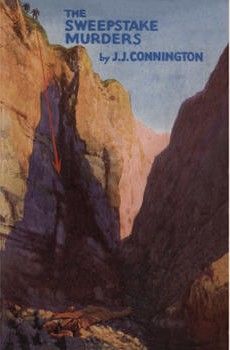
Review: The Sweepstake Mystery by J.J. Connington

by Eric

Although little remembered today, J.J. Connington, pseudonym for Alfred Walter Stewart (1880-1947), was a major writer of Golden Age Detective (GAD) fiction. A professor of chemistry, he found time to write one science fiction novel and seventeen mystery novels.

In The Sweepstake Murders a nine-man syndicate holds a winning ticket worth a quarter of a million pounds. Quite a sum, particularly in 1931, the year of publication. After one member dies in an airplane crash, court action by his estate delays the payout. The survivors agree that the prize will be shared equally by those still alive when the money is actually paid.

What could possibly go wrong?

Yes, that's right. Quicker than you can say "tontine," syndicate members begin to die in apparent accidents, starting with a tumble over the edge of a cliff at the delightfully named Hell's Gape. As syndicate members go down the value of the survivors' shares goes up. Obviously these guys should have read more mysteries before making that agreement.

Chief Constable Sir Clinton Driffield happens to be visiting the countryside, staying with one of the syndicate members, his friend Wendover -- the sort of gentleman of leisure so often featured in novels of the era. And a lucky thing too because the local police inspector while brilliant at collecting evidence is not as good as Sir Clinton at putting everything together. At least not putting it together the right way.

The suspense never lets up because the reader is kept guessing who the next victim will be. For those of us who never manage to figure out the killer, the ever dwindling number of suspects at least gives us a decent chance of making a blind guess.

The mystery becomes increasingly complicated because each new "accident" needs its own explanation. Connington belonged to the "fair play" school, which is to say he presents the reader with all the clues the detective has, all the clues necessary to solve the mystery. In a sense a novel like this is a huge puzzle. Everything the writer relates might be a clue, or a red herring.

Connington offers a huge variety of evidence for each of the multiple murders: personal entanglements, financial motives, timing sensitive alibis, physical and forensic clues, to name a few. You have to love a mystery where the solution depends on disparate clues like photographs and punctuation. Oops. I hope I didn't give anything away there. Unless you're a real mystery puzzle expert I doubt it.

And who is expert at figuring out complicated puzzles these days when practically every mystery is required to be in large part a psychological drama or thriller? Personally I think rationality is as much a part of human makeup as our underlying psychology or emotions like fear or love and therefore as worthy of being a subject of literature, even if publishers and academics disagree.

An interesting aspect of this book is that the mystery hinges in part of technology of the era, some of which was rather new in 1931. However much a novel like this might seem old fashioned, Connington was right up to date.

I happen to enjoy GAD mysteries. To me, they are much more inventive than the tiresome cookie-cutter mayhem we get too much of today (Hey, there's an idea -- The Cookie-Cutter Serial Killer!). The Sweepstake Murders is an excellent example of the Golden Age detective novel.